
Retail media networks have long operated as black boxes. Advertisers pour billions into sponsored placements but rarely get a clear answer to: Why was my ad shown to that person, at that moment?
Now, AI and Machine Learning are creating even more complex, opaque models for advertisers. While the AI and ML may be improving the retailer's revenue per impression, advertisers still demand transparency in order to grow their investment.
At Kevel, we believe control and transparency for both the retailer and the brand are increasingly important to drive revenue growth. That is why we developed Kevel Intelligence.
This article is about how we approach relevancy, not as a feature we bolted on to stay competitive, but as the core decisioning layer our platform is built around.. We will show you what it does out of the box, how it works at a technical level for those who need to know, and how it scales as your network matures. Whether you are running a lean team that needs strong defaults or a sophisticated program with your own data science capability, the same engine serves across both ends of that spectrum.
Better relevancy drives increased ad and sales revenue. When the right ad reaches the right shopper at the right moment, three things happen that directly affect your network's commercial performance.
- Incremental revenue increases. Irrelevant ads waste impressions that could have generated yield. When relevancy improves, each impression works harder, and the revenue from low-quality matches starts to compound.
- Fill rate improves. You likely have relevant ads sitting in your inventory that are never surfacing. The reason is usually architectural: platforms that do not separate filtering, targeting, and relevancy end up restricting matches to exact categories or keywords. Better relevancy surfaces what you already have.
- Advertiser ROAS improves. When ads convert at higher rates, advertisers see it in their numbers and grow their budgets. That flywheel, better relevancy, stronger performance, more spend, is how retail media networks grow their advertiser base without constantly chasing new demand.
Kevel Intelligence, your relevance layer
Kevel Intelligence makes the technology previously reserved for the largest advertising networks available to any retail media program. This allows retailers to have a more even playing field to compete for ad revenue, so your advertisers get results that are competitive with any platform.
Advertising relevance is multi-dimensional. Matching an ad to a search term is just the starting point. Truly optimised ad ranking balances shopper intent, historic performance, auction dynamics, campaign goals, and audience affinity, all at once, in real time.
The goal is simple, even if the execution is not: the best ad for the shopper should also be the best ad for the network. When relevancy is working properly, those two things are not in tension. An ad that feels right to the shopper converts better, performs better for the advertiser, and generates more sustainable revenue for the retailer. Kevel Intelligence is built around that principle, across all five dimensions.
Kevel Intelligence provides machine learning models out of the box across all five of these dimensions. You can deploy a sophisticated AI approach for your advertisers from the start, without building it yourself.
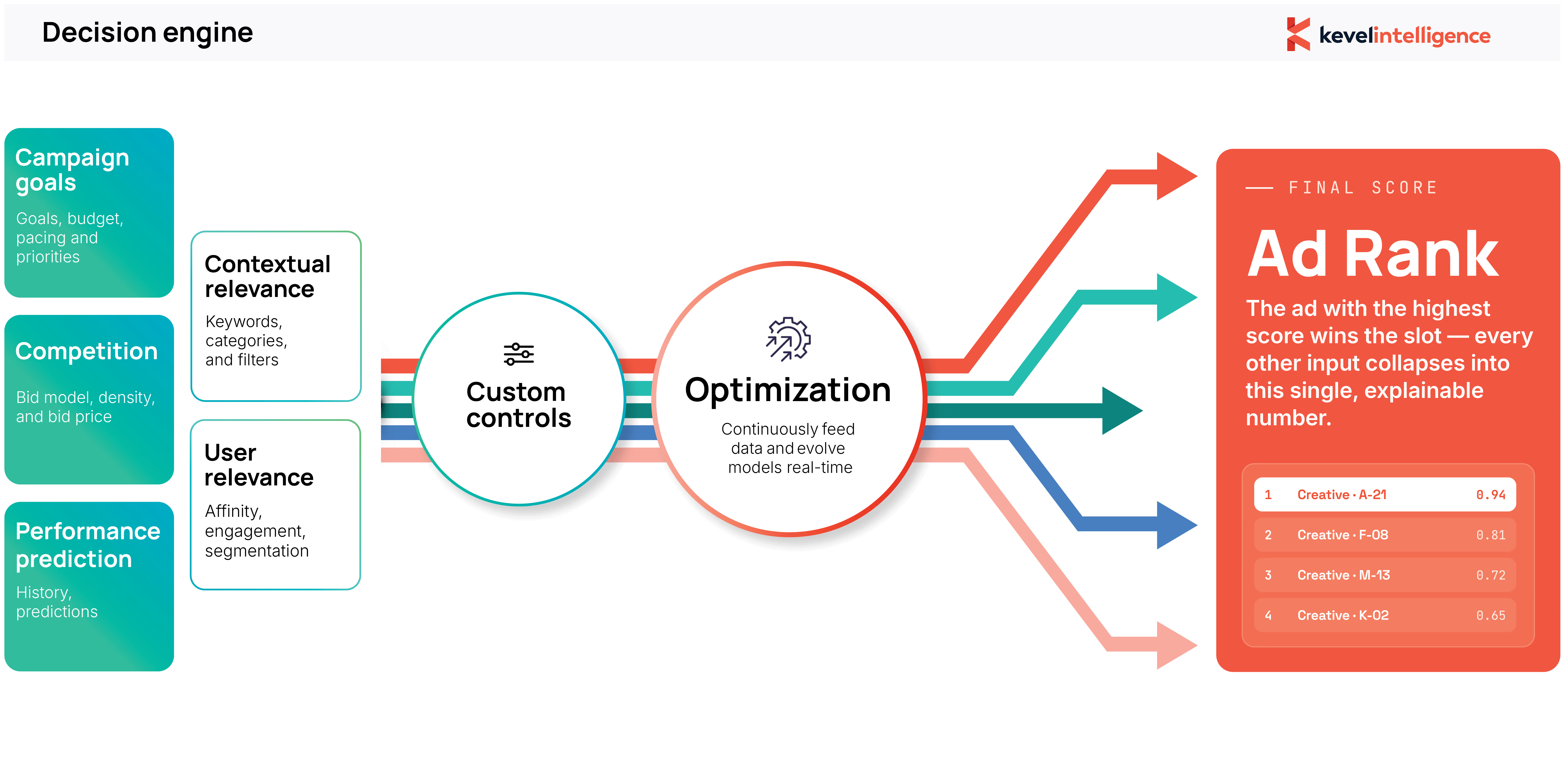
Kevel's approach to model training is one of strict independence. Your models are trained exclusively on your own network's data. What your platform learns about your shoppers stays entirely yours.
This independence also means the models respond to your reality in real time. A campaign pacing too quickly to its daily budget, a sudden traffic spike, a new-to-brand shopper arriving for the first time: each of these changes should alter the relevancy calculation instantly. Kevel Intelligence is consistently adapting, so the engine will reflect more of what is actually happening in your network right now, not what was happening when the model was last trained.
Because no two retail businesses optimise for the same outcomes, you also control how each dimension is weighted. A subscription business optimising for lifetime value needs the engine tuned differently than a marketplace optimising for impression volume. Kevel Intelligence is constantly evolving to give you those controls so you can use them immediately, without rebuilding anything.
Grow with your ambitions
Every retail media program has a different starting point and grows at its own pace. Kevel Intelligence is built for all points of that spectrum, built to grow with you at every stage.
If you are starting out, the out-of-the-box models across all five relevancy dimensions provide sophisticated AI decisioning that is ready when you are, no data science team required.
If you are running a more advanced program, those same defaults become a foundation you build upon rather than a ceiling you hit. Weight the models differently, go deep with a focused advertiser set or broad across a long tail, inject your own signals, or replace components entirely with your own logic. The platform is designed for it.
Explainable, bring your own models (BYOM)
Kevel Intelligence gives your team full visibility into how the ad server makes decisions, so you can learn from it, improve it, and explain it to your advertisers with confidence.
Your team holds knowledge that sits outside any platform: an understanding of your traffic patterns, your advertiser relationships, your audience behaviour, and your product catalogue. Kevel is built to bring that knowledge into every serving decision, layering it on top of the platform's own models to strengthen each serving decision in real time.
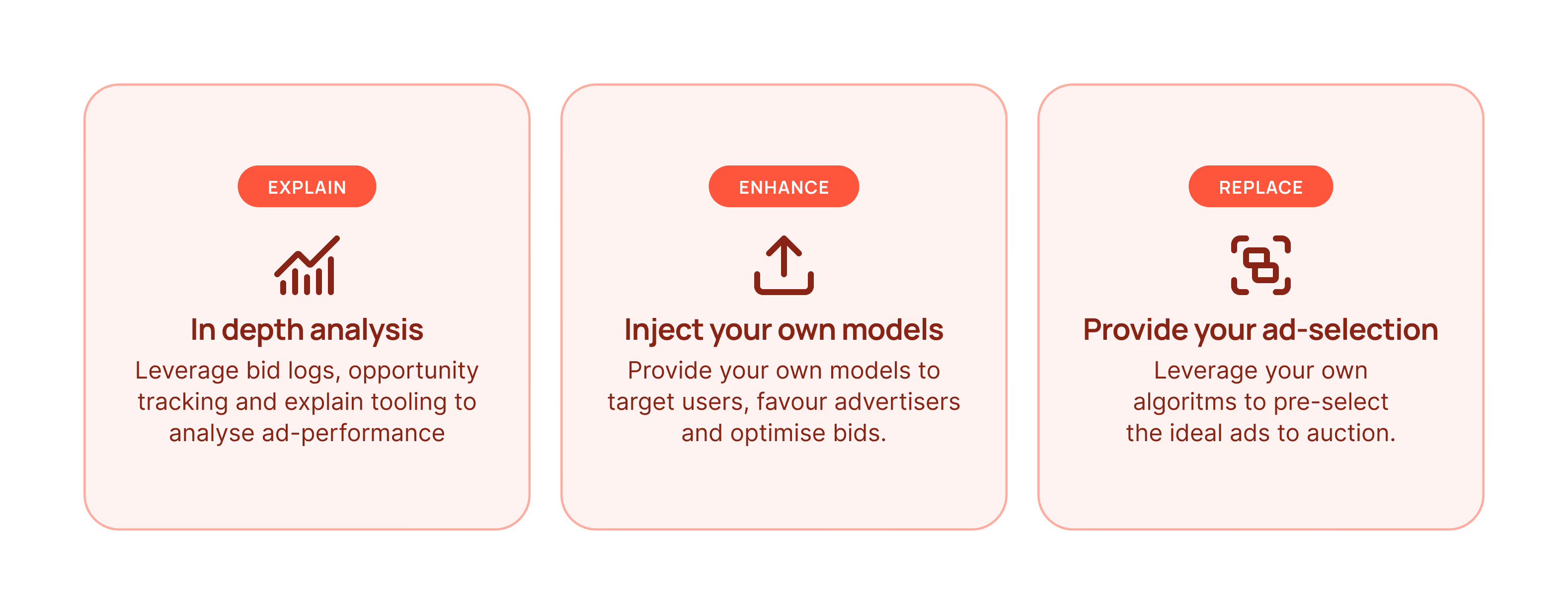
Explain:
Understand performance
For every ad placement opportunity, Kevel provides a detailed log covering which ads were available, the candidates selected and how the final ranking was reached. Your team can see exactly how the AI influenced each decision, which signals were fired, how they were weighted, and what the outcome was. This is not aggregate reporting. It is per-decision explainability.
This matters because advertiser scrutiny is increasing and transparency is non-negotiable. When a campaign underperforms, advertisers want answers. Kevel Intelligence gives you the tools and information to provide in-depth answers. Capabilities like incrementality go further still, giving you the proof needed to retain advertiser confidence and grow their budgets over time.
Enhance:
Control and add your own models
Kevel allows you to bring your own AI models directly into the ad serving decision, across the entire pipeline from initial candidate selection through to runtime decisions, like advertiser exclusions and bid adjustments.
We commonly see our customers building on top of Kevel:
- Behavioural models: Behaviour learned about users that influences their affinity, often coming from internal Data Science teams (e.g. your own relevancy scores).
- Integrations: Connections to data solutions already in use, such as CDP’s (e.g. Adobe Experience Manager).
- Signals specific to a shopper's current journey, their loyalty status, their entry point, and the context only you have can all enrich the auction in real time.
Kevel is fundamentally geared towards a sustainable architecture of control and extensibility. This extensibility applies across the most advanced parts of ad serving, too, including auto-bidding, goal optimisation, and forecasting. The architecture is designed for it.
We collaborate with your team to identify how your algorithms, whether that's offline models on, for example, product/brand affinity or even live models of click-stream prediction (e.g. journey based), can enrich the decision regarding which ad to serve.
Replace:
Replace specific models with your own
The emergence of highly personalised placements (e.g. App Feed, Recommenders) where complex AI models such as k-NN, Collaborative filtering and Hybrid approaches drive the selection of relevant products - set a new challenge for ad-servers.
You can provide your own pre-selected pool of ads at runtime and rely on Kevel to handle the final selection based on bids, pacing, frequency caps, and availability.
Using Auction-as-a-Service gives you complete control over relevancy while retaining the full value of the ad technology in maximising your revenue outcomes.
Across Explain, Enhance, and Replace, the principle is the same: Kevel provides the foundation and the controls. You decide how far you take it.
Retailer Takeaways: Questions to ask your partners on Relevancy & AI
The right questions separate platforms that talk about relevancy from those that have actually built it. We think every retailer should be asking these of us and of anyone else they evaluate.
On sophistication and coverage: Does the platform's relevancy model account for all five dimensions of ad ranking, contextual relevance, user affinity, competition dynamics, campaign goals, and performance prediction, or does it go deep on one and use simple defaults for the rest?
On data ownership and model isolation: Are models trained exclusively on the retailer's own first-party data, or does the system pool signals across multiple retailers to train shared models?
If the retailer leaves the platform, what happens to the models and the data that trained them?
On transparency and explainability: For any given auction, can the retailer's team see which signals fired, how they were weighted, and why a specific ad won? Not in aggregate, per decision.
On control and flexibility: Can the retailer bring their own models into the decisioning pipeline, or are they limited to the signals and weights the platform provides?
On growth and maturity: What does the platform look like for a team with no internal data science capability versus one with a full modelling function? Is it the same platform, or two different products?
On partnership and dependency: Who controls the evolution of relevancy models? Does improving them require the vendor's involvement, or can the retailer's own team drive that independently?

Paulo Cunha