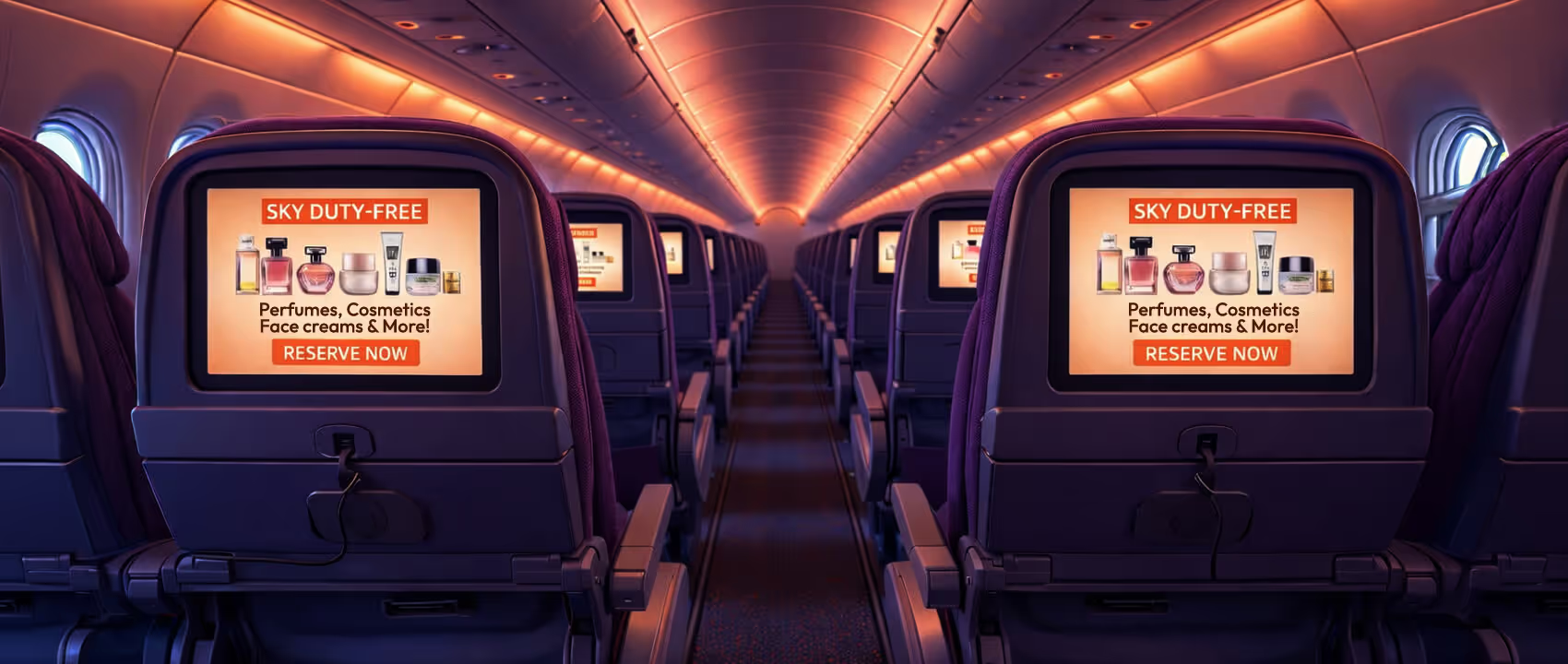
Travel brands have quietly become some of the most valuable advertising real estate on the internet, and most of them don't even know it yet. Expedia's Travel Media Network generated over 275 million impressions from a single campaign with Visit California. United Airlines pulled in $110 million in new ad revenue within its first year of launching Kinective Media. Thomas Cook's purpose-built media division now generates $100 million annually at an estimated 60% margin. Meanwhile, eMarketer projects travel media ad spend will surpass $2 billion by 2026, growing at a CAGR approaching 18%.
The opportunity is no longer hypothetical, it's infrastructure-level. Every airline booking, hotel search, and loyalty login is a high-intent signal that advertisers would pay significant premiums to access. Travel brands own those signals. What most have been missing is the operational, technical, and strategic playbook to turn attention into a media business.
This guide fills that gap. Whether you're an OTA with millions of monthly active users, an airline with a captive inflight audience, or a hotel group sitting on years of loyalty data, this step-by-step playbook covers everything you need to plan, build, and scale a Travel Media Network from the ground up, without giving up control of your data or your customer relationship.
What Is a Travel Media Network (and What It Is Not)?
A Travel Media Network (TMN) is an owned advertising platform operated by a travel brand, airline, OTA, hotel group, cruise line, rail operator, that monetizes its audience and digital inventory through targeted advertising, using its own first-party data. It is the travel industry's evolution of what retail media has been for Amazon, Walmart, and Kroger: a high-margin revenue stream that leverages existing audience relationships instead of renting reach from third-party platforms.
The word "network" here is deliberate. A TMN is not:
- A banner ad placement on your website that gets filled by Google AdSense
- A one-off sponsored content deal with a travel brand
- A third-party ad network running tags across your pages
Without owned infrastructure, first-party data, and deliberate advertiser relationships, it's just inventory, not a network. The distinction matters because inventory gets commoditized; networks compound in value over time as data and demand grow together.
What makes TMNs uniquely valuable compared to traditional retail media is the depth and specificity of traveler intent. A search for "business class flights to Singapore" tells you far more about a consumer's purchasing power, travel frequency, and interests than a supermarket basket ever could. Travel platforms sit at the intersection of high-income consumers, life-event triggers (weddings, relocations, vacations, business travel), and high-spending decision moments. That combination is what makes travel audiences so compelling to both endemic advertisers (hotels, car rentals, travel insurance) and non-endemic brands (luxury goods, financial services, premium lifestyle).
The Commerce Media Context
TMNs exist within the broader boom of commerce media, advertising that connects consumers to products and services throughout the buying journey. Commerce media budgets surpassed an estimated $150 billion globally in 2025, with travel as one of the fastest-growing non-retail verticals. Understanding this context matters because your TMN will compete for the same advertiser budgets as retail media networks, meaning you'll need to match, or exceed, the targeting, measurement, and self-service standards those networks have set.
Step 1: Define Your Vision and Revenue Goals
Every successful Travel Media Network starts with a vision, not a product. Before you evaluate ad tech vendors or hire an ad sales team, you need clarity on three things: what you want the business to be, who it serves, and what success looks like in 12, 24, and 36 months.
Crawl, Walk, Run Roadmap
The most resilient TMN launches follow a phased approach. Rushing to build a full omnichannel media network before you've validated demand or infrastructure is one of the most common ways these programs stall.
Phase 1 (Crawl): Launch on-site sponsored placements within your existing booking flow or search results. This requires the least infrastructure, generates early revenue, and lets you validate which ad formats resonate with your users and which advertisers convert.
Phase 2 (Walk): Expand to email, app notifications, and any other owned channels where you have a logged-in audience. Begin building audience segmentation based on booking behavior, loyalty tier, and travel intent.
Phase 3 (Run): Activate off-site, extending your first-party audience data into programmatic channels, CTV, social, open web, and offer non-endemic advertisers access to your traveler segments at scale. Introduce self-serve tooling for advertisers who want direct access.
Revenue Goal Setting
Be realistic about your starting point. Most TMNs take 12-18 months to reach meaningful revenue at scale, and the initial growth period can plateau quickly if the foundational data and measurement infrastructure isn't solid. Set internal benchmarks for: CPMs by placement type, fill rate targets, number of active advertiser partners, and advertiser retention rates. These metrics are your leading indicators long before total revenue becomes a useful signal.
Step 2: Audit Your First-Party Data Assets
Your data is the core product of your Travel Media Network. Advertisers are not buying banner impressions, they're buying access to intent-rich, authenticated traveler audiences. The strength, depth, and cleanliness of your first-party data directly determines what CPMs you can charge and which advertisers you can attract.
What Traveler Data You Likely Already Own
Most travel platforms are sitting on far more valuable data than they realize:
- Search and intent data: Destination searches, date ranges, class preferences, activity queries
- Booking data: Frequency, spend, brand preference, booking lead time
- Loyalty data: Tier status, redemption behavior, program engagement
- Behavioral data: App usage, content consumption, review behavior, inflight preferences
- Location data: Origin markets, common routes, destination clusters
Each of these signals is a targeting vector. A traveler who has searched for "beachfront resorts in the Maldives" four times in the past month is a different audience than someone who books one economy flight to Manchester per year. Your data lets you tell that story to advertisers.
Data Quality and Consent
The privacy shift has accelerated significantly. With the decline of third-party cookies and tighter browser restrictions, brands are urgently seeking consented, reliable first-party data. Travel platforms are uniquely positioned to deliver logged-in environments with rich user profiles, but only if data collection practices are robust and privacy-compliant.
Audit your current data infrastructure against these questions:
- What percentage of your users are authenticated (logged in) at the moment of ad exposure?
- Do you have a clear consent management framework that covers advertising use cases?
- Can you build and activate audience segments in real time, or are you working with batched, stale data?
- How do you currently share data with advertisers, and can you do so in a privacy-safe way (e.g., clean rooms)?
In 2025, 71% of publishers identified first-party data as a key source of positive advertising results, up from 64% the prior year. Investing in data quality now directly determines your pricing power later.
Building a Data Strategy That Grows
The more a network expands and grows its dataset, the more demand there will be from advertisers. Develop a strategy to grow your data through new loyalty member acquisition, richer behavioral signals, and data enrichment partnerships. Stronger, more granular data creates more targetable audiences, which yields better media performance and stronger attribution, the kind that makes advertisers come back.
Step 3: Map Your Inventory, Touchpoints Are Your Media
One of the conceptual shifts required to build a TMN is seeing your digital product through an advertising lens. Every screen, email, notification, and physical space that reaches your customers is potential media inventory. The question is: which of these placements enhances the customer journey while generating advertiser value?
The Full Inventory Landscape for Travel Brands
United Airlines' Kinective Media is a useful benchmark here, it spans airport displays, app inventory, emails, and inflight seatback screens, linking real-time traveler data (gate, route, flight status) to hyper-relevant ad delivery. That level of integration across the passenger journey is what differentiates a TMN from a simple ad placement business.
Prioritizing Placement Quality
Not all inventory is equally valuable, and filling every available pixel with ads is not the goal. The placements that command premium CPMs are those with: high user intent at the moment of exposure, contextual relevance to the traveler's journey stage, and clear measurement paths from exposure to action. Starting with three to five high-quality placements beats launching twenty mediocre ones. Build quality, validate performance, then expand inventory based on advertiser demand signals.
Step 4: Choose Your Ad Tech Infrastructure
This is where many TMN initiatives either gain momentum or lose months to vendor evaluations and infrastructure decisions. Your ad tech stack is the operational backbone of your network, it determines how ads are delivered, targeted, measured, and reported on.
The Build vs. Buy Decision
The central question is whether to build custom ad serving infrastructure in-house, license a turnkey solution, or use an API-first platform that sits between the two extremes.
Building fully in-house gives maximum control and customization, but requires significant engineering investment, typically 12+ months before the first ad serves. Few travel brands outside of the largest OTAs have the engineering capacity or time horizon for this approach.
Turnkey ad network solutions offer quick launches, but typically come with revenue share models, limited customization, and, critically, the requirement to route your first-party data through a third party's infrastructure. This undermines the data ownership advantage that makes TMNs valuable in the first place.
API-first ad platforms (like Kevel's Retail Media Cloud®) offer a compelling middle path: the flexibility to build custom ad formats, targeting logic, and reporting while dramatically shortening launch timelines. These platforms handle the infrastructure of ad decisioning, campaign management, and audience activation, letting your team focus on the commercial and product layer. Platforms like Kevel have enabled companies to grow ad revenue by 20x in a single year by providing the tools to build a differentiated ad platform without building everything from scratch.
Core Components of Your Ad Tech Stack
Regardless of your build path, a functioning TMN requires these components:
Ad Server: The engine that decisions which ad to show which user, based on targeting criteria, pacing rules, and business logic. Your ad server should support sponsored listings, native display, and custom formats without requiring you to conform to generic templates.
Audience Segmentation: A tool that converts your first-party data into activatable segments, by travel intent, loyalty tier, booking recency, and behavioral signals. Look for platforms that enable real-time segment activation, not just batched daily updates.
Campaign Management UI: An interface that lets your ad operations team (and eventually self-serve advertisers) create, manage, and optimize campaigns without needing engineering support for every change.
Reporting and Attribution: Closed-loop measurement that connects ad exposure to downstream actions, bookings, conversions, ancillary purchases. This is what advertisers will demand, and what differentiates your network from open programmatic.
For a deeper dive on how API-first ad serving works in practice for travel use cases, Kevel's native advertising guide and retail media build vs. buy analysis are worth reading before making infrastructure decisions.
Step 5: Build the Advertiser Go-To-Market Strategy
A Travel Media Network without advertisers is infrastructure with no revenue. Your go-to-market strategy determines who you sell to, how you package inventory, and how fast you can build a sustainable advertiser base.
Endemic vs. Non-Endemic Advertisers
Start with endemic advertisers, brands that already operate in the travel ecosystem and have the most obvious use case for your audience. Car rental companies, travel insurance providers, destination tourism boards, hotel chains, and luggage brands are natural first partners. They understand travel intent, already have marketing budgets allocated to travel channels, and are typically easier to close as early customers.
Once you've proven the model, non-endemic advertisers become a major growth driver. Financial services brands want high-income travelers. Luxury goods companies want frequent business travelers. QSR and CPG brands want captive inflight audiences. Uber demonstrated this at scale, the company now generates over $1 billion annually in ad revenue by monetizing its app real estate to CPG and QSR brands. The same model is available to any travel brand with sufficient logged-in audience volume.
Packaging Your Inventory for Advertisers
Advertisers want to buy outcomes, not placements. Structure your commercial offers around:
- Audience packages: "Reach 500,000 high-frequency travelers departing from top-10 business routes in Q3"
- Journey-stage packages: "Own the pre-departure moment, email, app push, and check-in page, for 60 days"
- Sponsorship bundles: Exclusive ownership of a channel or content category (e.g., "Official Travel Insurance Partner of [Your Brand]")
Avoid selling individual placements in isolation, especially early on. Bundled packages are easier to value, easier for advertisers to justify internally, and build the relationship that drives repeat spend. As Sam Wright, former head of retail media at Klarna, noted when building Klarna Media: brands want full transparency into where their spend is going and proof that it's working, not just a line item for "digital display."
Self-Serve vs. Managed Service
Early in your TMN's life, a managed service model is appropriate, your team runs campaigns on behalf of advertisers, providing white-glove support while you learn what works. As volume grows, self-serve capabilities become critical. By 2025, self-service has become the industry standard expectation for retail media networks, and travel is following the same arc. A self-serve portal reduces your operational costs per campaign while enabling smaller advertiser budgets to participate, widening your addressable market.
Ready to start growing?
Step 6: Solve for Measurement Before You Sell
Measurement is the most common barrier to advertiser trust, and the most common reason Travel Media Networks plateau after an initial growth period. Advertisers want clear evidence of return on ad spend, and they're increasingly sophisticated about demanding it.
What Advertisers Will Ask For
By the time you approach your first advertiser conversation, you should have a clear answer to each of these questions:
- Attribution: How do you connect an ad impression to a downstream booking or ancillary purchase? What attribution model do you use (last-click, multi-touch, or incrementality-based)?
- Incrementality: Can you run lift studies to prove that your ad drove a booking that wouldn't have happened otherwise?
- Audience verification: How do you validate that the audience the advertiser purchased actually saw the ad?
- Off-site measurement: If you're extending audience data to off-site channels (CTV, programmatic), how does attribution flow back?
Expedia has invested heavily in building out measurement capabilities, integrating lift studies, multi-touch attribution, and audience lookalikes, with clean room technology as a future enabler for privacy-safe data sharing. The standard they're setting will eventually be the baseline expectation for all TMNs.
Clean Room Infrastructure
Clean rooms, secure, privacy-compliant environments where data can be matched and analyzed without raw data exposure, are becoming standard infrastructure for mature TMNs. They enable advertisers to bring their own customer data and match it against your audience segments to measure reach, overlap, and conversion lift, without either party exposing raw user-level data. If clean room infrastructure is beyond your current technical capacity, acknowledge it transparently with early advertisers while putting it on the product roadmap.
Starting Simpler: Proxy Metrics That Build Trust
You don't need closed-loop attribution on day one. Start with verifiable proxy metrics: verified impressions by segment, click-through rates by placement, conversion rates to booking initiation. Combine these with audience composition reports that demonstrate the quality of who saw the ad. Build from there to more sophisticated incrementality studies as your tech stack matures. The key is never overpromising measurement before you can deliver it, your advertiser relationships depend on credibility, not just reach claims.
Step 7: Launch, Learn, and Scale
The launch phase is where theory meets reality. Keeping the initial scope narrow, focused on a small number of high-quality placements, a manageable set of early advertiser partners, and tight measurement coverage, is almost always the right call.
Soft Launch with Anchor Partners
Rather than a full public launch with an open advertiser marketplace, identify three to five anchor advertisers to work with through your soft launch phase. These should be brands with strong brand safety reputations, reasonable creative demands, and a willingness to work collaboratively while you iterate. Their campaigns will generate the performance data you need to build your commercial narrative.
A common creative barrier in early TMN sales conversations: advertisers' creative budgets are often insufficient for testing a new partner. Offering co-creative support, helping develop ad creatives as part of your managed service removes this friction and accelerates time-to-campaign.
Iteration Loops
Establish a weekly or biweekly review cadence during your first six months: What placements are delivering strong CTR and CPMs? Which audience segments convert most efficiently for which advertiser categories? Which ad formats (sponsored listings, native display, video) generate the highest advertiser satisfaction? Use these insights to refine your inventory strategy, packaging, and pricing.
Scaling Offsite
Off-site extension, using your first-party traveler segments to reach audiences across programmatic web, CTV, and social, is typically where travel media businesses find their largest revenue upside. A global travel brand tested first-party data on CTV with Madhive and cut conversion costs in half while reaching incremental audiences unreachable through their owned channels alone.
The playbook for off-site extension generally follows this sequence: validate on-site performance → build confidence in audience segment quality → partner with a demand-side platform (DSP) or programmatic technology partner to activate off-site → measure lift against a control group. See how commerce media networks are extending beyond owned platforms for more context on this evolution.
The Common Pitfalls That Stall Travel Media Networks
Understanding where other TMNs have stumbled is as valuable as the positive playbook.
Starting with Inventory Instead of Infrastructure
The most repeated mistake is treating ad placements as the product rather than the customer data and delivery infrastructure. "Without these elements, it's not a media network, it's just inventory," as one analyst in the space put it bluntly. Placements without targeting are display advertising. Display advertising without attribution is brand awareness at low CPMs. Build the data and measurement foundation first; the inventory value follows.
Separating Data from Media
As Dr. Mark Grether of PayPal Ads framed it in a conversation on the Unlocking Retail Media podcast with Kevel CEO James Avery: "If you really want to monetize your audience data, you need to combine it with media." Travel brands that sell audience data access independently from media inventory typically leave significant revenue on the table and create governance complexity that slows everything down.
Scaling Too Fast, Too Early
Many retail media networks, and TMNs follow the same pattern, experiencing 12 to 18 months of initial growth before hitting a plateau. This often happens because they scaled advertiser commitments before the data, measurement, or creative support infrastructure was ready to sustain them. Advertiser churn at this stage is far more damaging than a slower initial ramp.
Ignoring the Customer Experience
Your travelers are not an audience to be monetized at any cost, they're customers whose loyalty is your most valuable long-term asset. Every placement decision should be evaluated against whether it enhances or degrades the user journey. Placements that feel intrusive, irrelevant, or excessive will erode the trust that makes your first-party data valuable in the first place. Before a media network, put the customer first.
FAQs
What is a Travel Media Network and how is it different from a retail media network?
A Travel Media Network is an owned advertising platform operated by a travel company, airline, OTA, hotel chain, that monetizes its audience using first-party traveler data. Like a retail media network, it leverages direct customer relationships and closed-loop data to deliver targeted advertising. The key difference is the audience: travelers represent high-income, high-intent consumers at life-event moments, making travel data particularly valuable to both endemic (travel-adjacent) and non-endemic (luxury, financial services) advertisers.
How much revenue can a Travel Media Network realistically generate?
Revenue potential varies significantly by audience size, data quality, and inventory breadth. United Airlines generated $110 million in new media revenue in its first year with Kinective Media. Thomas Cook's Partnerships & Retail Media Division generates $100 million annually at approximately a 60% margin. Smaller travel brands with focused audiences should expect a longer ramp, typically 12-24 months before reaching eight-figure annual revenue. Early CPMs for premium, logged-in travel audiences typically range from $10 to $30+, with sponsored listing placements often commanding higher rates.
Do I need to build my own ad server to launch a Travel Media Network?
Not necessarily. The build vs. buy decision depends on your engineering capacity, timeline, and customization requirements. Fully custom builds offer the most flexibility but typically require 12+ months and significant developer resources before the first ad serves. API-first platforms like Kevel's Retail Media Cloud offer a middle path: the ability to launch custom ad formats and targeting in weeks rather than months, while retaining full ownership of your first-party data. Turnkey ad network solutions launch fastest but sacrifice data control and customization.
What types of advertisers should a Travel Media Network target first?
Start with endemic advertisers, brands that already market within the travel ecosystem. Car rental companies, travel insurance providers, destination tourism boards, hotel chains, and luggage brands have clear use cases for traveler audiences and existing budgets allocated to travel channels. Once performance is established, expand to non-endemic advertisers: financial services, luxury goods, and premium consumer brands that value high-income traveler demographics.
How do I handle measurement for Travel Media Network advertisers?
Measurement is the most critical trust-builder with advertisers. At launch, start with verifiable proxy metrics: authenticated impressions, CTR by placement, and conversion rates to booking initiation. As your infrastructure matures, build toward closed-loop attribution connecting ad exposure to downstream bookings or ancillary purchases. Incrementality lift studies are increasingly standard. Clean room technology enables privacy-safe data matching for more sophisticated advertiser measurement needs. Never overpromise measurement capabilities before you can deliver them, credibility is harder to rebuild than a slower start.
Can a small travel brand launch a Travel Media Network?
Yes, scale matters, but it's not the only determinant of success. Companies with far less traffic than Expedia or United have successfully launched advertising businesses by focusing on niche audiences with high-value signals. A boutique cruise line, a regional airline, or a travel metasearch site all have access to audiences that niche advertisers will pay significant premiums to reach. The key is leading with data quality and specificity, not raw impression volume. According to industry practitioners, building a retail media network is accessible to companies ranging from low millions to hundreds of billions in revenue.
What is the biggest mistake travel companies make when launching a media network?
The single most common error is starting with inventory, deciding where ads will appear, before building the data and measurement infrastructure that makes those placements valuable. Placements without targeting and attribution are just commodity display advertising. The strongest Travel Media Networks start with infrastructure: a clear data strategy, a consent-compliant collection framework, and measurement architecture. The inventory value compounds from there. Related to this: scaling advertiser commitments too quickly before the operational foundation can support campaign quality and reporting.
Conclusion
The rise of Travel Media Networks is not a trend, it's a structural shift in how travel companies monetize the one thing they've always had but undervalued: owned audiences with deep, verified intent signals. The travel brands winning in this space are treating their media networks the same way they'd treat any mission-critical revenue function: with deliberate infrastructure investment, clear governance, and a patient, phased approach to scaling.
The playbook is clear. Define a phased vision before touching technology. Audit and invest in your first-party data as your primary commercial asset. Map your touchpoints as a media portfolio, not an afterthought. Choose ad tech infrastructure that keeps you in control of your data and your customer experience. Build advertiser relationships around measurement and trust, not just reach. And scale, carefully, with the customer journey always as the governing constraint.
Travel brands that act now have a rare structural advantage: their competitors are still renting attention from Google, Meta, and Amazon. Every dollar of ad budget spent on a TMN is a dollar captured from that ecosystem, earning premium margins on data assets travel companies already own. The question isn't whether to build, it's whether to build early enough to matter.